Integrating Physical Science in Cross-Curricular Learning
Discover how integrating physical science in cross-curricular learning enhances critical thinking, problem-solving, and student engagement by connecting science with mathematics, technology, engineering, and everyday life.
SCIENCE
6/15/20264 min read
Cross Curricular Focus Physical Science: Connecting Science to Real-World Learning
Overview
“Modern education is moving away from the individual subjects to integrated learning experiences. A very successful strategy in today's classrooms is the cross curricular emphasis physical science paradigm. This method of teaching links physical science topics with other academic disciplines and aids students in understanding the importance of scientific concepts on daily life, technology, society, and the environment.
Science should be taught as a cross-curriculum focus physical science, not as a stand alone subject. Students can learn about scientific principles through math, engineering, technology, language arts, history, geography, and even the arts. This results in greater understanding and enhances critical thinking skills that allow students to transfer information to a variety of situations.
What Is Cross Curricular Focus Physical Science?
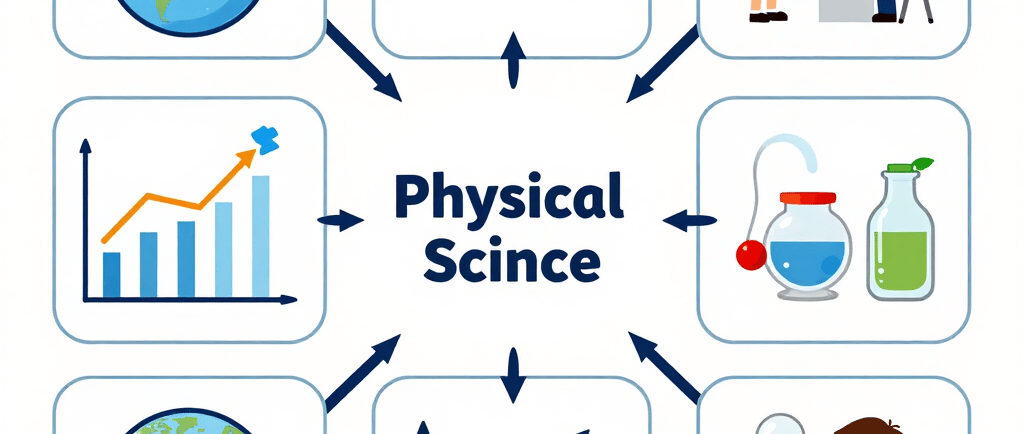
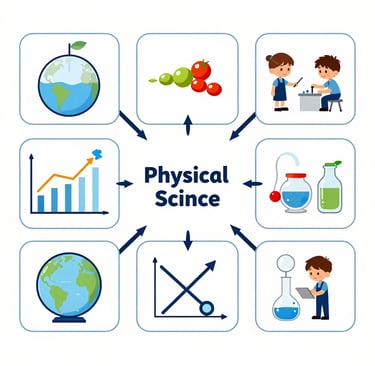
A cross curricular emphasis physical science framework combines physical science themes with learning goals from other subject areas. Physical science usually encompasses the study of matter, energy, motion, forces, electricity, magnetism, sound, light, and chemical reactions.
Linking students to other fields helps them to see these issues in a larger context and to gain skills beyond scientific knowledge.
Example:
Mathematical graphs as a model for understanding motion
Environmental studies: Energy renewable
Learning about significant scientific breakthroughs in history courses
Generating research reports on language arts science innovations
Developing engineering solutions from physics concepts
This technique, which cuts across disciplines, makes learning more interesting and relevant.
The Importance of Cross Curricular Learning
A robust cross curricular emphasis physical science plan brings many educational advantages .
1. It Increases Student Engagement
Students ask, “What do I need to learn this for?” Cross-curricular teaching addresses that concern by demonstrating real-world applications of scientific principles.
2. Improves Critical Thinking Skills
Connecting knowledge across topics helps students to learn how to analyse information, solve complicated issues and think creatively.
3. Enhances Knowledge Retention
Research repeatedly reveals that children learn topics better when they are exposed to them in multiple circumstances.
4. Assists You in Solving Real-World Problems
Most real world problems are not easily boxed into one topic area. A cross-curricular emphasis physical science strategy prepares students for future vocations and daily decision making.
Physics and Mathematics
Mathematics and physical science are inherently related. Many scientific notions are based on calculations, measurements and data analysis.
Examples are:
Computations of speed and velocity
Force and acceleration measurements
Analysis of Energy Consumption
Mapping movement patterns
Reading scientific data
Students learn how mathematical models can explain physical occurrences and facilitate scientific study.
Physical Science and Technology
Technology has an important part in scientific education nowadays. Students may examine via a cross curricular emphasis physical science framework:
Robotics, 22 (2), 278–289, 2013.
Computer Simulation
Numerical experiments
Coding apps
Machine intelligence
Technologies for renewable energy
Technology helps learners visualise scientific topics and build practical digital skills.
Physical Sciences and Engineering (PSE)
Engineering is a great way to use knowledge of the physical sciences.
Students may engage in initiatives such as:
Bridge-building
Solar gadget design
Build model cars
Build water filtering systems
Creating sustainable energy solutions
These hands-on exercises illustrate the role of scientific laws in engineering design and innovation.
Language Arts and Physical Sciences
Many teachers are unaware of the strong relationship between science and literacy.
A physical science lesson with a cross curricular emphasis may look like this:
Scientific research writing
Reading informative text
Scientific results reporting
Creating scientific journals
Holding discussions on scientific subjects
Good communication skills are vital for scientists, engineers and researchers.
Environmental Studies and Science
Environmental issues provide excellent opportunity for cross-disciplinary learning.
Students could investigate:
Climate change
Alternative energy
Conservation Tactics
Sustainable development
Carbon footprints
Resources Management
These themes help students appreciate the impact of physical science on the natural world and human civilisation.
History and Physical Science
Science and technology develop . History offers background.
Students may look into:
Industrial Revolution
Space travel
Electrical evolution of
Scientific discoveries
Contributions of Notable Physicists
Technological innovations across history
Students learn about the growth of scientific knowledge and understand historical advancements.
Cross Curricular Focus Classroom Activities in Physical Science
Teachers may provide fun exercises that include different disciplines.
Energy Audit Project
Students learn how much energy the school consumes, determine the cost, and recommend ways to make it more efficient.
Integrated Subjects:
Sciences Physiques
Math
Economics
Environmental Studies
Challenge: Design a Bridge
Students learn about forces and structural engineering as they create and test model bridges.
Subjects added:
Physik
Teknik
Math
Design & Technology
Studies of Green Energy
Students are taught about solar, wind and hydro power sources.
Integrated Subjects:
Science: Physical
Geography
Environmental Science
Language Arts
Science Journalism
Students produce news stories regarding scientific breakthroughs.
Subject incorporated:
Sciences
Writing
Media Literacy
Communication
Cross Curricular Focus Skills Developed Physical Science
The students develop a wealth of transferable skills such as:
Investigation
Solving problems
Critical thinking
Analysis of data
Research ability
Communications
Collaboration
Ingenuity
Creativity
Project management
Making decisions
Digital literacy
These skills are highly prized in university studies and the current labour market.
Problem and Solution
There are several benefits to using a cross curricular emphasis physical science strategy; nevertheless, educators may confront problems with curriculum alignment, time limitations, and assessment obstacles.
Some such solutions are:
Collaborative planning of lessons
Learning by projects
Integrated Assessment
Flexible teaching methods
Educational technology use
Career development programs
With careful preparation, schools may effectively incorporate several disciplines into scientific training.
Cross Curricular Focus on Physical Science: The Future
As education evolves, so does interdisciplinary learning become more vital. The future professions will demand people who can integrate knowledge of science, technology, engineering, mathematics, communication and environmental studies.
A well-designed cross curricular emphasis physical science curriculum helps students acquire the problem solving and adaptation skills required for success in the 21st century.
Conclusion
The cross curricular emphasis physical science turns standard scientific education into a dynamic and relevant learning experience. By integrating physical science with mathematics, engineering, technology, language arts, history, and environmental studies, students get a more profound grasp of scientific principles and their real-world applications.
As schools are increasingly adopting multidisciplinary education, a cross curricular emphasis physical science framework will be an important technique to prepare students to think critically, create imaginatively, and address the complex issues of the future.
Join our community and stay connected through our social channels.
© 2026. All rights reserved.