
Upskilling vs. Reskilling: Understanding the Key Differences
Understand the key differences between upskilling and reskilling. Learn how both strategies help employees develop new skills, adapt to workplace changes, improve career growth, and support long-term organizational success.
EDUCATION
6/19/20264 min read
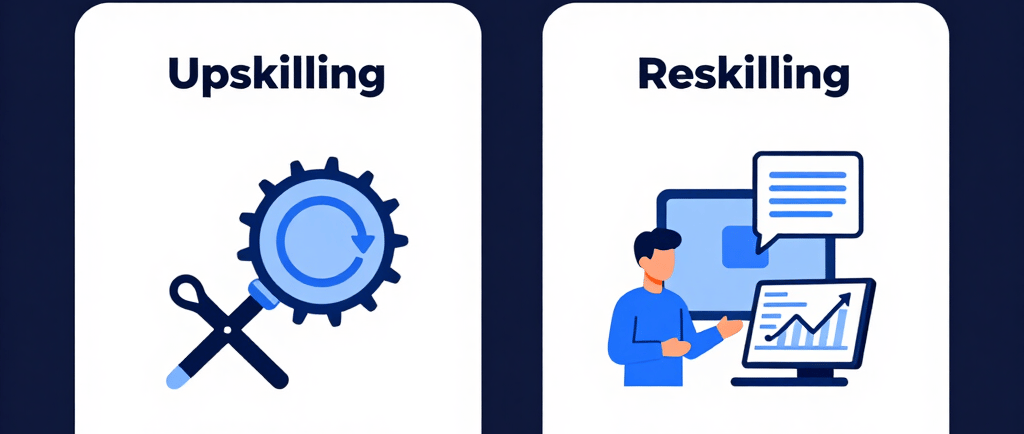
Upskilling versus Reskilling – What’s the Difference?
One thing is certain in today’s fast-changing work landscape: learning doesn’t cease when you graduate. With new technology, automation, artificial intelligence and changing business demands transforming sectors , the pace of change is quicker than ever before . Hence, individuals and companies are spending more on staff development to be competitive.
This brings us to a key question: Upskilling vs. Reskilling: What’s the Difference?
The phrases are sometimes used interchangeably, but they are really two different approaches to career progression and employee development. Understanding the distinction may help people make better career choices and assist organisations create a workforce ready for the future.
Upskilling, What is that?
Upskilling is the process of gaining new skills to benefit you in your present work or career path. personnel may increase their productivity, enhance their present skills and remain up to date with developments in the area without having to leave their positions.
“Upskilling is about doing better the things you do now.
Examples of upskilling
Data Analytics Training for Marketing Professionals
An electrician taking advanced automation courses.
A project manager working on a certification in Agile techniques.
HR professional trying out AI based recruitment tools.
Software developer , working in the field of cloud computing technology.
Upskilling is the process of improving your skill set to become more efficient in your work and to be ready for a promotion in the same industry.
What is re-skilling?
Reskilling is the process of acquiring new skills in preparation for a new profession, industry or career path. This is occasionally essential when present work become outdated owing to technical developments or changing market needs .
Reskilling is learning how to perform a different job.
Examples of upskilling
A manufacturing worker moving toward industrial automation.
A digital marketing expert to a store worker.
A tech getting the basics of cybersecurity in a practical way.
Administrative assistant position with data entry or IT assistance.
Customer service executive who became a software tester.
Reskilling may help people stay marketable and ready for new jobs in changing industries.
Upskilling and Reskilling – What’s the Difference?
The biggest difference is the direction their careers take.
Upskilling
Builds existing skills
Supports current role
Emphasises job growth
Broadens skillset
Improves current job performance
Reskilling
Builds new skills
Supports new role
Emphasises job change
Broadens flexibility
Improves current job performance
Prepares for future role
In Upskilling vs. Reskilling: What’s the Difference?, upskilling is like moving higher on your existing professional ladder, while reskilling is like switching to a whole other ladder.
The relevance of upskilling today
Technology is changing almost every employment. People who keep improving their skills are the ones who are most likely to be regarded and competitive in the field.
Benefits of Upskilling
Additional earning opportunities
More employment security.
Improved professional development
Higher productivity at work.
Increased confidence and competence
Improved career development
Better leadership skills
Organisations also profit as competent individuals can drive innovation, operational efficiency and commercial development.
Why Upskill
Digital transformation, automation, machine learning and artificial intelligence are reshaping many occupations. Some conventional types of work are disappearing, while whole new forms of employment are being established.
Advantages of Reskilling
New employment opportunities
More employable
Collaboration with the industry
Less likelihood of unemployment
More labour flexibility
Careers in Sustainability
More prepared for the future work market
It usually costs less to retrain people you already employ than it does to bring in new people.
When to upgrade?
Upskilling is good when:
You like what you are doing now.
Your business is changing swiftly.
You want to be in charge or up front.
You demand high technical skills.
You want to increase your marketability.
For example, an electrical technician could study industrial automation, PLC programming, smart grid technologies or renewable energy systems to remain up to date with the latest developments in the field.
When to Re-train
If reskilling is the right choice:
Your industry is dying.
Your employment is being stolen by machines.
You need a fresh start in your career.
There's a better chance elsewhere.
There are development areas related to your interests and goals.
A worker in a dying business may retrain for a position in cybersecurity, cloud computing, data science, health technology or digital marketing.
The Responsibility of Employers to Upskill and Reskill
Top companies know that developing people is the key to long-term success.
Companies are pouring into:
Employee training programs
Learning platforms
Certification
Programs for workforce change
Courses on leadership development
Digital skills training
Technical Education Courses
Culture of continuous learning
Companies that invest in staff development are more likely to see greater retention, better performance and more innovation.
How to Begin Your Upskilling or Reskilling Journey
If you’re unsure where to begin, try these out:
1. Evaluate Your Current Skills
Know your strengths, issues and areas of improvement.
2. Industry Trend Analysis
What skills are necessary for your goal industry / occupation?
3. Set professional goals
Decide whether you want to advance within your current position or a new one.
4. Region training
Sign up for courses, workshops, certifications, internships or tech-programmes.
5. Get hands-on experience
Put your new expertise to use on projects, freelance work, voluntary activities or corporate work.
## 6. Commitment to Continuous Learning
The finest professionals are always investing in their skills and career development.
Abstract
What’s the difference between upskilling and reskilling?
Upskilling is about improving and broadening your skills in your present work, while reskilling is about preparing you for a whole new profession or sector. Both are genuine and are becoming more crucial in today’s rapidly changing company.
One of the best choices you can make for career progress, job stability, professional development or a whole new career is to invest in learning.
“The future belongs to people who believe in lifelong learning, who embrace change and who continue to develop the skills the workforce of the future will need. This is the first step in building a successful future-ready career.
Join our community and stay connected through our social channels.
© 2026. All rights reserved.